Directing, Not Button-Press
In short: Part 1 ended on a wall — specifically, a wall my image model invented in the wrong spot three times in a row. And on the question of what's left for someone like me amid all the tool magic. Here's the answer. The KLECKO spot is fully AI-produced — but it wasn't AI-directed. One child became two, because relationships are more interesting than action. A "chocolate flood" became exactly two kilograms, because a product has a quantity. Seventeen seconds became thirty, because rhythm isn't a technical number. Around sixteen calls like that sit inside the spot — plus my most honest admission: in this pipeline test I deliberately left a pile of continuity errors in. My takeaway after that day: the easier image-making gets, the more film knowledge matters. AI needs more of it, not less.
The wall that wasn't there
Let's start exactly where Part 1 left off.
Storyboard frame five was supposed to show the two kids painting on the living-room wall with the spread. The first generation invented a brand-new wall for that. The second attempt, given the later closing frame as an extra reference, still invented another conveniently placed surface. Technically both images were usable. As film, they were wrong.
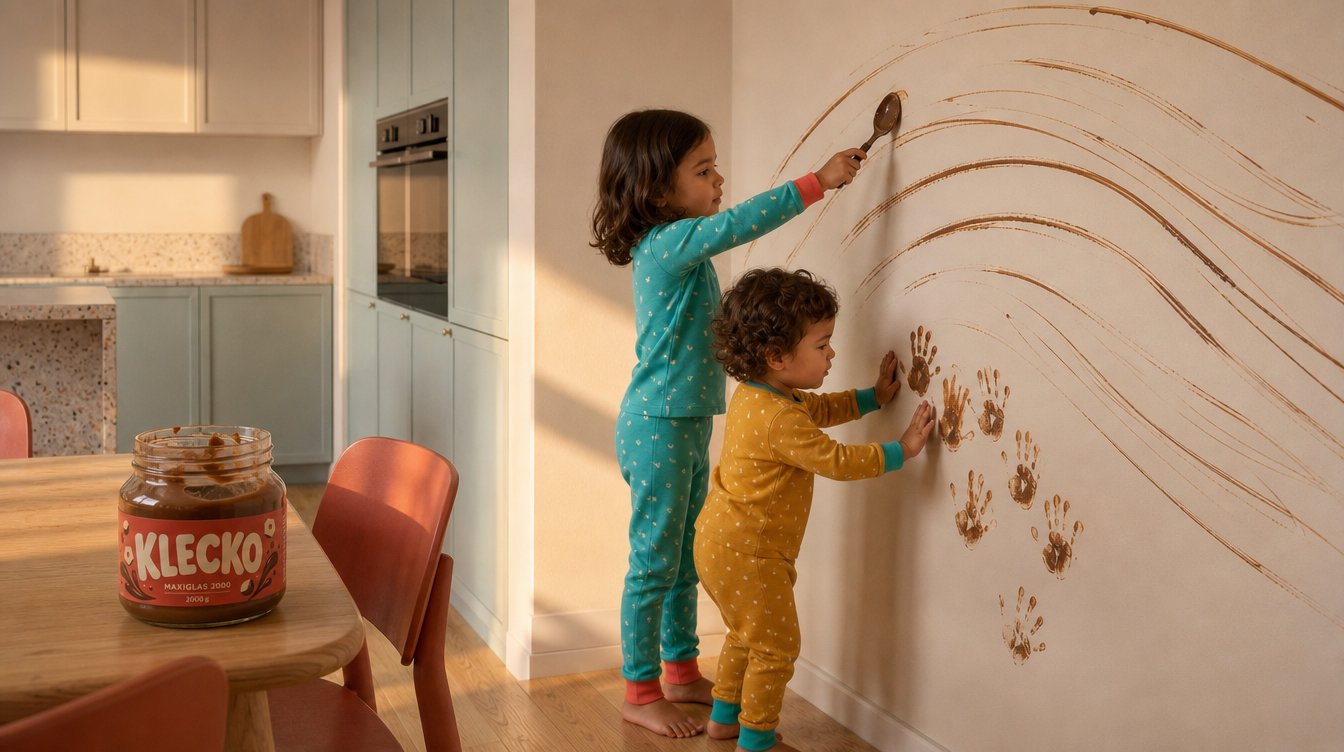
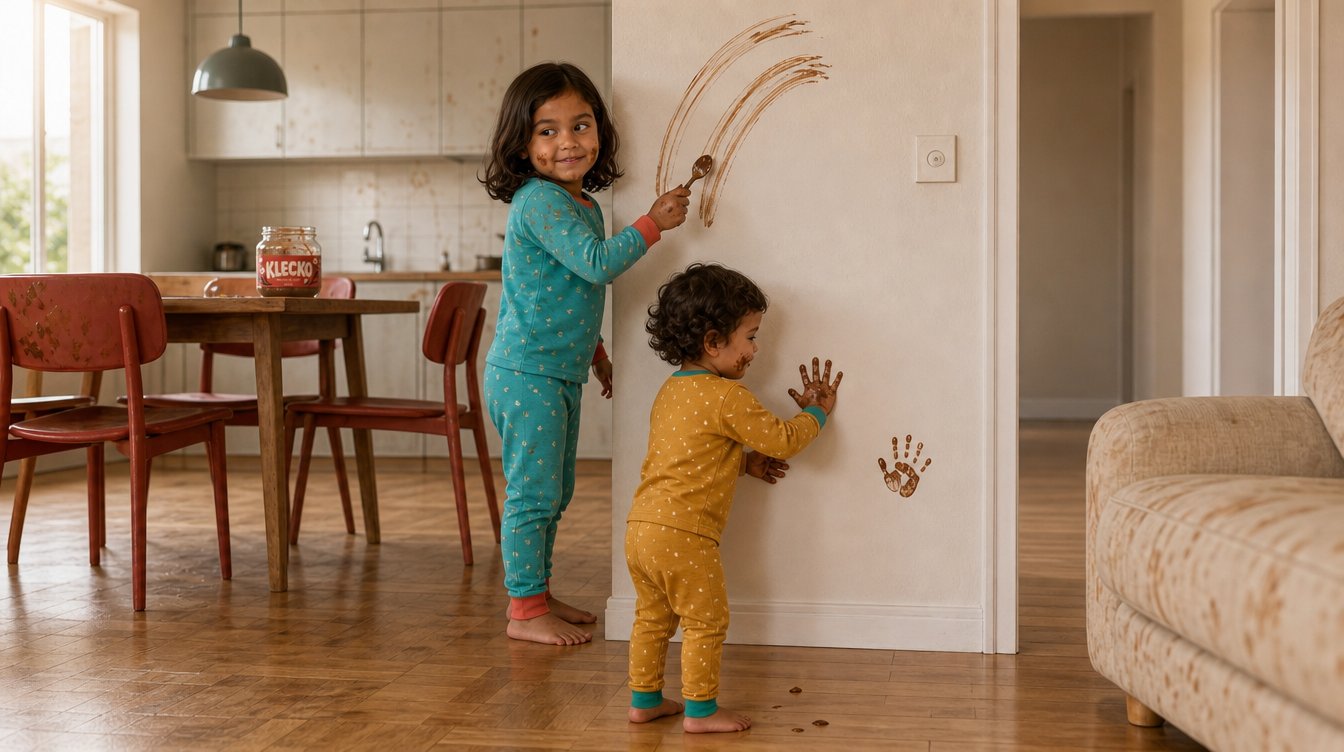
My fix wasn't a more poetic prompt. It was reverse engineering: the later frame 9 became the sole architecture and camera reference. I removed the extra room images so the model couldn't blend views. Door opening, wall edge, sightline, furniture spacing — locked. And the instruction, unmistakable: the action adapts to the room, not the room to the action. Don't invent walls. The third version finally held.
Honestly, what went through my head in that moment was mixed. I'll say it straight:
"My first reflex was annoyed — why don't you catch this yourself? A second later came the other one: ok, good, so a human is still needed after all."
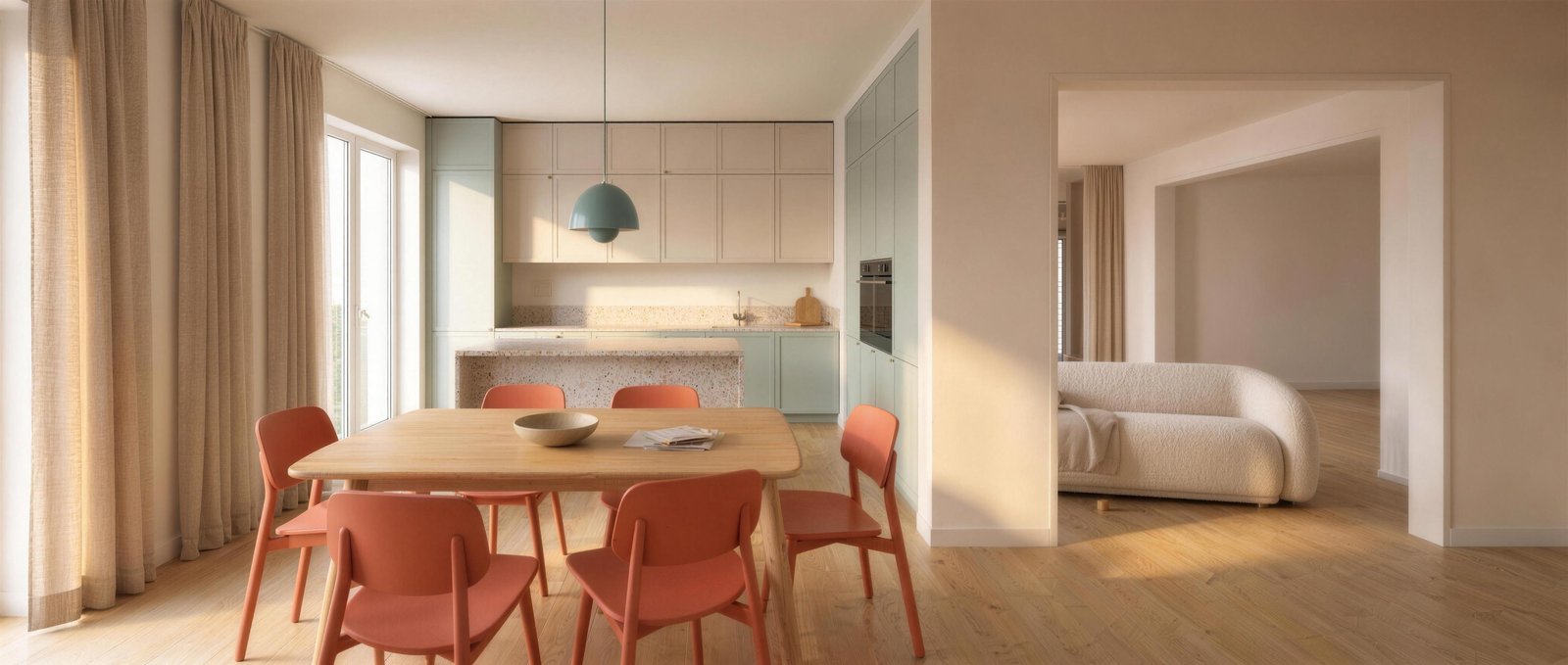
That's the core of it. Image models treat rooms like elastic sets. If the action needs a wall, one gets invented. If a camera axis is inconvenient, a door slides over. For a single image, nobody notices. In a film, continuity dies of it. So the apartment had to be treated like a real location — with a binding floor plan from a panorama stretched to 21:9: where's the kitchen, which wall actually exists, where's the light coming from. The panorama wasn't the bigger picture. It was the spatial truth of the production.
One child became two
The first draft of the treatment had a single three-year-old. During development I turned that into two sisters, three and five.
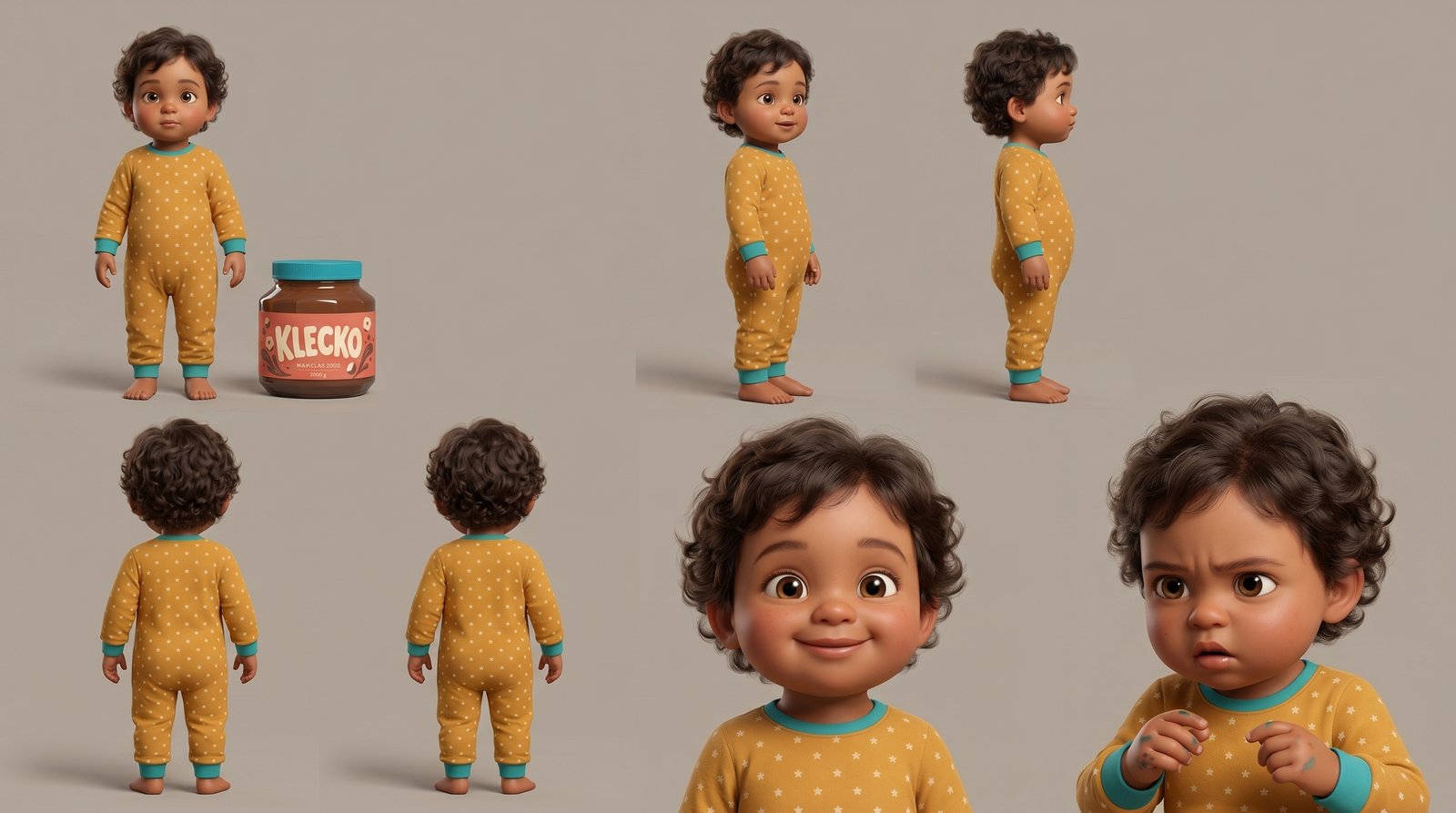
That sounds like a casting nuance, but it was a dramaturgical call. A single child causes chaos. Two children develop an idea together: a glance that opens the game; the older one spotting a chance in the first smear; the younger one following, delighted; egging each other on; a conspiratorial closing look. The AI didn't propose that improvement. It came from one question: what's more interesting in front of the camera? Directing here means staging relationships, not just describing an action.
Photoreal isn't the same as believable
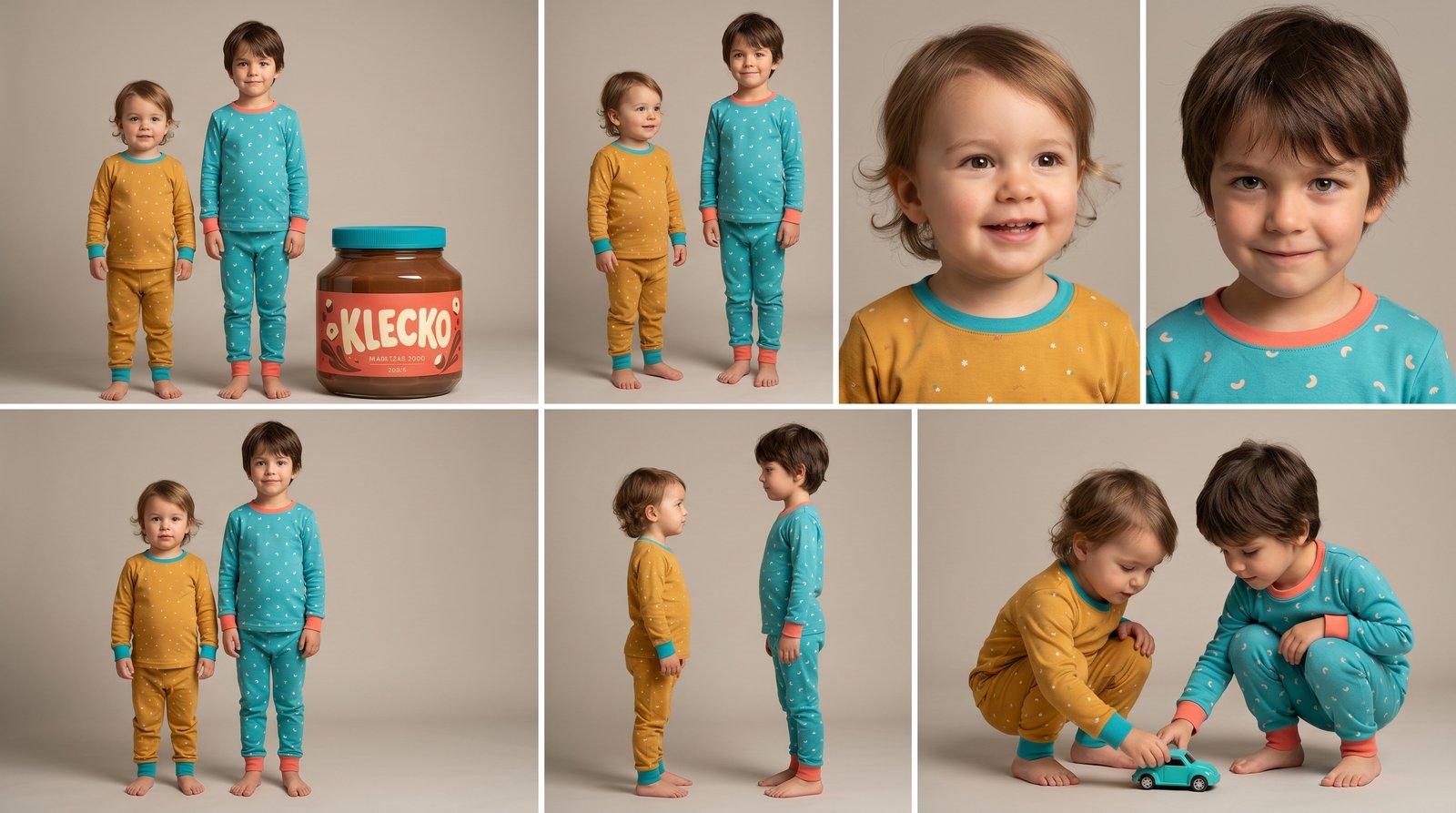
An early location sheet was technically clean but looked like an architectural rendering: surfaces too perfect, materials too smooth, an apartment too unlived-in.
My move was a binding realism lock — natural skin, baby hair, real fabric fibers, age-appropriate proportions, small signs of use, slightly imperfect furniture placement, morning light, no plastic skin, no CGI look. The word "photoreal" wouldn't have covered it. An image can be photographically detailed and still look completely artificial. Film sense shows in small imperfections: a fold of fabric, a wall texture, a light edge. You have to want those — the model won't suggest them on its own.
Control over button-press: nine frames, two kilos, one jar
Three decisions from the same family — all of them saying no to the convenient default.
Nine separate frames instead of one 3×3 button. An early test tried to generate all nine storyboard beats in a single composite. Efficient — but imprecise: if one moment in that grid is wrong, a correction shifts the others with it. So: nine separate keyframes, one clear action each, the same character, product and room references, every image judged individually, montaged only afterward. A model interpretation became a controllable shot list. Classic pre-production.
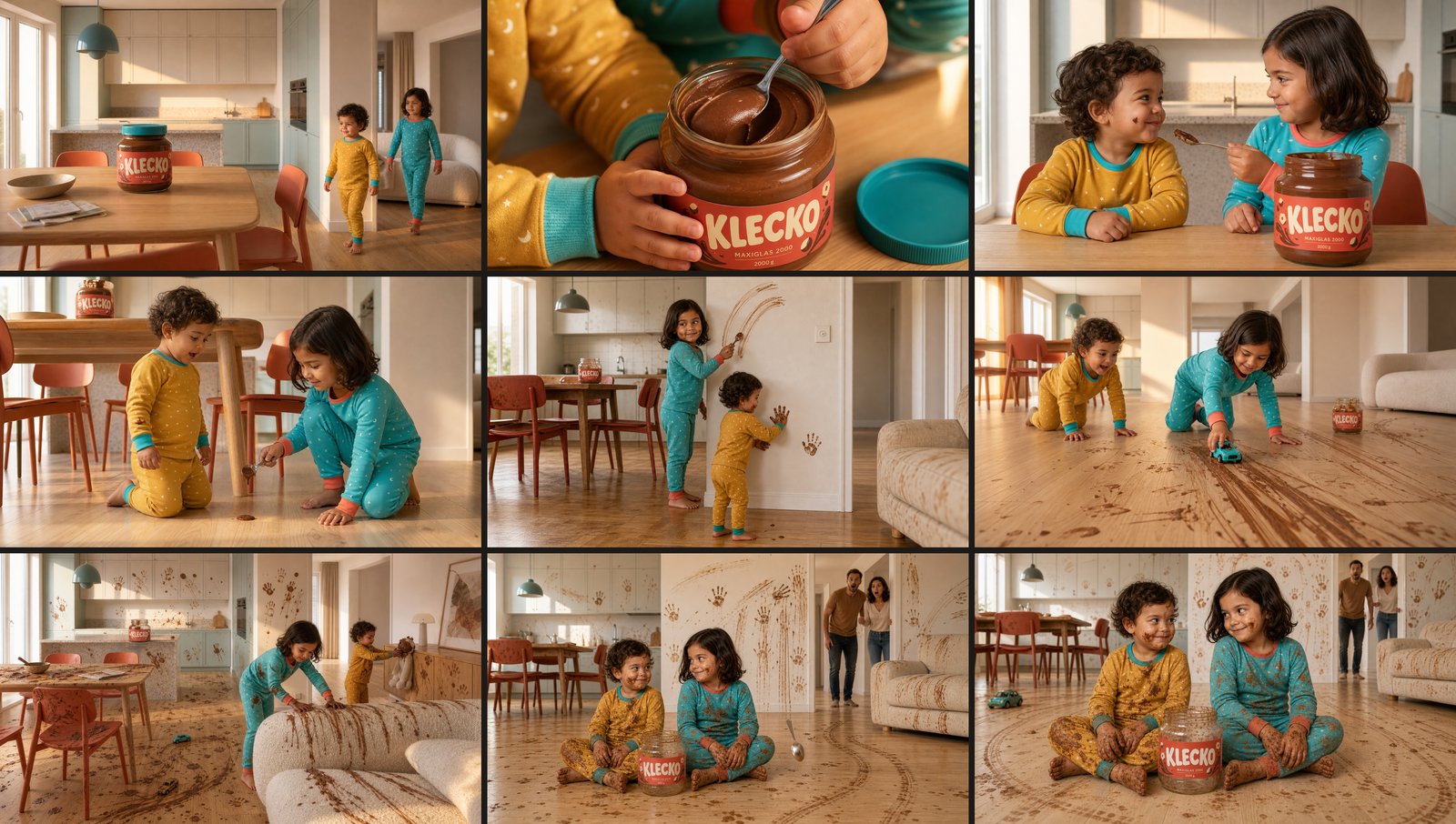
Two kilos stay two kilos. The story was meant to get absurd, nearly the whole apartment full of KLECKO. An early closing frame solved that as a chocolate flood — the floor inches deep in places. Spectacular, but wrong: the jar holds exactly 2000 grams. So I built a quantity plan — a few thick starter blobs, many thin spoon lines, fingerprints, long tire tracks from the toy car, flat sofa streaks. The chaos comes from maximum reach, not impossible mass.
The fill level became a prop. The jar wasn't allowed to look full again in every shot. So I tracked its state across the story: full at the start, three-quarters after the first smear, half while painting, under a third after the tire tracks, nearly empty before the finale, scraped clear at the end. A high-res chaos reference looked first-rate — and got cut anyway, because the jar still read as full on it. The most technically impressive image doesn't win; the one that tells the story correctly does.
What was still missing in the edit
Children's laughter isn't a sound track, it's a performance. The first video passes were generated without native sound, because the cut and mix were planned in Resolve. On review it was clear: the laughter is part of the staging — a dropped-in sound library would never have hit the motion exactly. So a second video pass with the same images as reference: synchronized giggling, footsteps, the spoon, sticky handprints, the short silence when the parents appear, the dry closing line.
And seventeen seconds isn't a thirty-second spot yet. After the first rough cut there were about seventeen seconds of action. The story worked, the format didn't. Instead of artificially slowing the film down, I shot additional setups: a detail while painting, a handprint, secret nibbling, a chocolate dot on the nose, a small high-five. The packshot gets six full seconds at the end — logo, product and claim hold long enough to be read and remembered. Runtime simply isn't a technical number. Thirty seconds have to be filled with rhythm.
The honest weakness: continuity errors I left in
Now the part most people would leave out. Not me.
This spot is not a flawless, glossy render — on purpose. It was a pipeline test: I often took only the first or second attempt per image and clip, no cherry-picking from twenty runs. The result is honest, but imperfect. There are continuity errors.
"The AI beats the human exactly when the human has no time — or doesn't take any. A lot of images have illogical continuity: smears on a wall that were there in one shot are gone in the next. Lots of small continuity slips you'll miss without care. The AI thinks of a lot — but not of everything."
That's not a contradiction of the thesis, it's the proof of it. The model optimizes the single image for effect. Whether that effect stays possible within the world of the film — whether the smear from shot 4 is still there in shot 5 — it doesn't ask. That question is directing. And it costs exactly what I deliberately didn't invest in the test: time and care, shot by shot.
What the automation did really well
To be clear: this isn't a reckoning with AI. The opposite — the automation was enormously helpful. Models and parameters addressed centrally, reference images passed between tools, variants in minutes, outpainting and upscaling that stabilized the location, prompts and jobs logged, storyboard strips built automatically, video jobs launched in parallel. The agent even helped sort and discarded weak variants.
All that production organization ran over an agentic stack — and honestly not over my hands on the code, but over Codex and the MCP layer that wired the crafts into one steerable pipeline. That's exactly how it should be: I set the direction and decide, the system executes. But organization isn't direction. Someone had to say: that's not the same apartment. That wall doesn't exist. The jar can't be full again. The laughter is missing. The rhythm doesn't carry thirty seconds yet.
Even a locked claim needs sound direction
One last small thing that ties it all together. For the end card I handed over logo, product and claim as fixed start and end frames. The prompt explicitly forbade a spoken claim. The model still read the visible line out loud, quietly, in the first version. Visually usable, wrong in the sound direction. A second pass demanded nonverbal sounds only — whoosh, glass click, pops.
The sentence I take from that almost sounds like it's from a completely different engine room: a generation job reported as "done" is not yet an approved shot. Only review and sound control turn it into usable footage.
Conclusion: AI needs more film knowledge, not less
The easier it gets to generate images, the more important it becomes to judge them. You still have to understand dramaturgy, character relationships, casting, shot sizes, axes and spatial continuity, lighting, prop continuity, production design, quantity and motion logic, comic timing, sound design, advertising rhythm, the packshot. AI lowers the technical barrier to making images — and at the same time raises the volume of material you have to decide on. The bottleneck shifts from making to selecting, correcting and directing.
"It's good to feel that human creativity is still stronger than any AI — for now. The decisions that mattered — story, slogan, shot — I made them and changed them. I directed. That's simply still needed."
And so I don't get ahead of myself, the honest flip side right away: it doesn't make me feel safe. The AI keeps getting better, the field is filling up, the market is finite and flooded. Finding your place in it means out-delivering others and specializing. The directing layer is my specialization — but it's no free pass, it's a job I have to defend anew every day.
Outlook: the value that remains
And that's exactly where Part 3 picks up. Because a single spot — even a well-directed one — isn't the real value. The value is the second clip. Episode two with the same kids, the same apartment, the same product, the same light — and then the whole season, consistent across hundreds of shots. That's where a "nice gag" turns into a real craft. I want to build a complete series-production suite that carries exactly that.
Part 3 next Friday: why scaling — not the single clip — is the real skill, and what remains once generation itself has become a commodity.
Sources
This field report rests, in substance, on my own production data — the directing documentation, the prompts, the storyboard and asset states of the KLECKO production from 25 June 2026. These internal records aren't publicly linkable; the calls described (two children instead of one, the threefold wall attempt, the 2000-gram quantity plan, the tracked fill level, the second sound pass, 17 → 30 seconds, six seconds of packshot) come from that log.
The few external terms are standard tools: Seedance 2.0 as a video model, ElevenLabs for voice and music, DaVinci Resolve for cut and mix, MCP (Model Context Protocol) as an open standard for an AI agent to call tools.
AI disclosure: The KLECKO spot itself is fully AI-generated and labelled as such (parody, fictional brand, no real product). The making-of images in this article are AI-generated production stills or work-in-progress screenshots — they illustrate the process.
Jens Fehrmann does AI-assisted video and series production in live-action and 2D style — real productions with AI as a pipeline component, for agencies, production companies, brands and creators. New production methods in use first, delivered reliably. Backed by experience in film and CGI since 2010, from Dresden.
Keep the conversation going?
Prefer LinkedIn? Let’s connect there. Prefer one-on-one? Message me directly — you reach me, not a team.