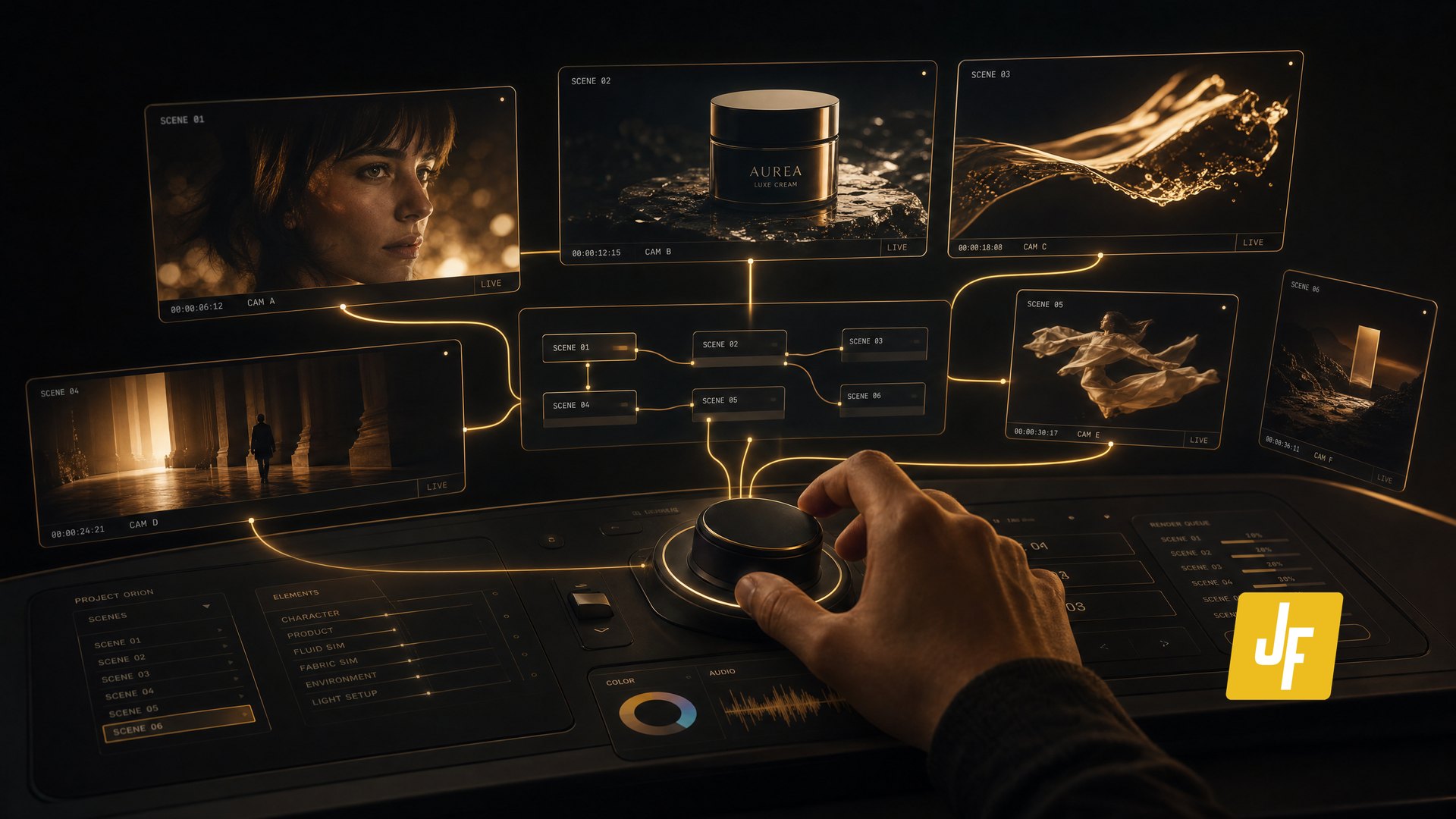
Higgsfield's MCP vs. My Own Pipeline
In short: I've spent months building my own skill system across my repos — small Markdown "skills," a lean orchestration layer, gates that let nothing unverified through. Then I took apart Higgsfield's brand-new MCP/skill kit — the very tool this spot was built with. The surprise: a strikingly similar approach to mine. Markdown skills, a CLI underneath, size limits, offloaded references, eval suites, approval gates. On top, Higgsfield adds a thin MCP layer for the agents — which I don't have (yet). Two teams, independently, the same underlying pattern. That's exactly why I built the ad — as proof I actually ran the kit end-to-end: an over-the-top parody for a made-up chocolate spread, in a single day. What you're about to see is only a 720p "Fast" preview (test quality, first or second attempt). And once the orchestration layer becomes a commodity, one question forces itself: what's left for someone like me?
The spot: "KLECKO Maxiglas 2000"
Fully AI-generated parody (fictional brand), 720p "Fast" preview — AI disclosure per EU AI Act, Art. 50.
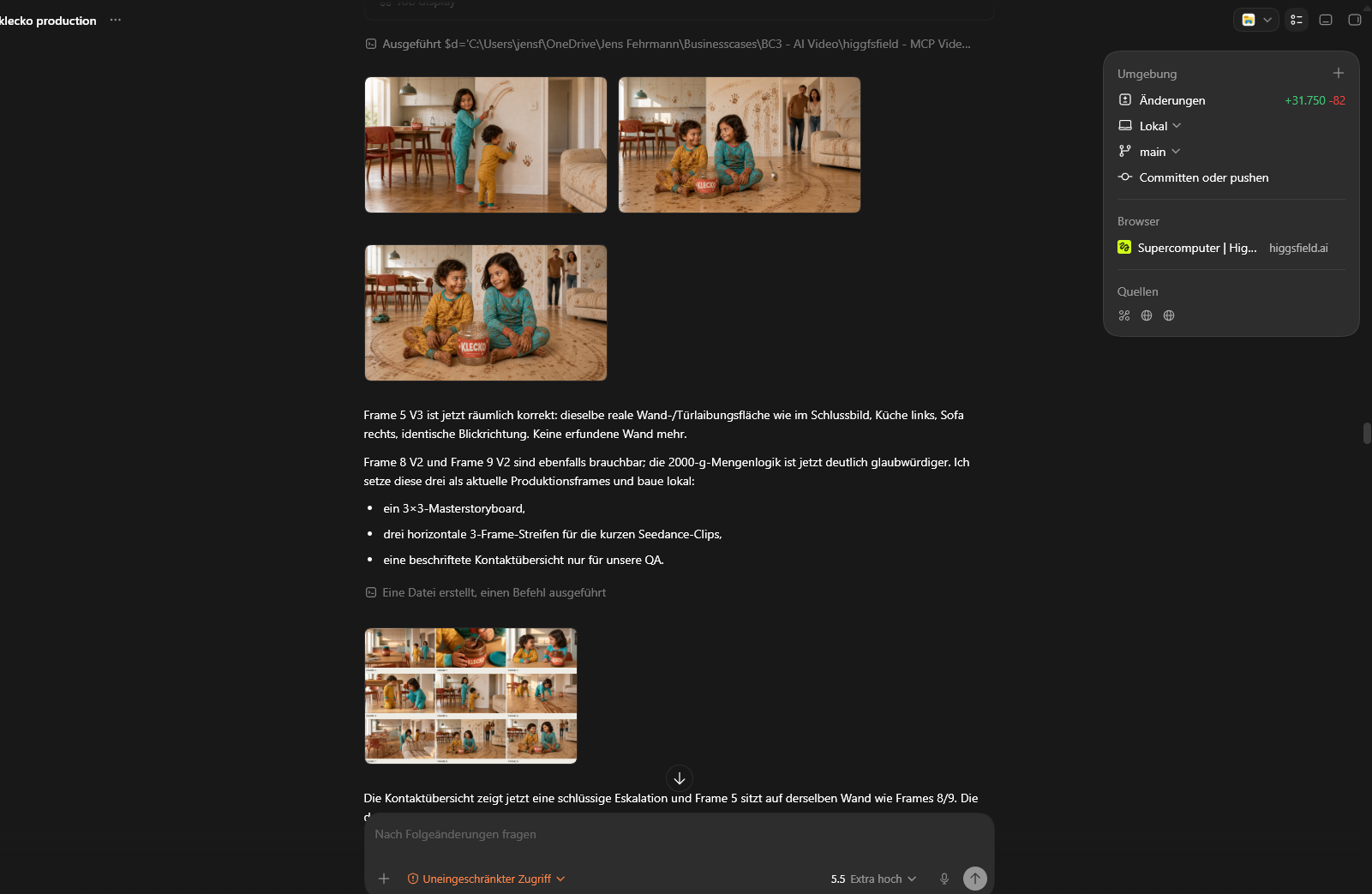
Two sisters, three and five, find a giant jar of chocolate-hazelnut spread one morning. First a spoonful. Then the first smear. Then the apartment turns into a canvas: walls, sofa, a toy car drawing brown tire tracks across the living room. By the end the jar is empty, the parents are speechless, and the little one grins straight into the camera — big end card, fat claim. A parody of every family food commercial you know. Made-up brand, no real product, all fictional.
That's the visible end. The interesting part is how it came together — and how fast.
Two tools, one day
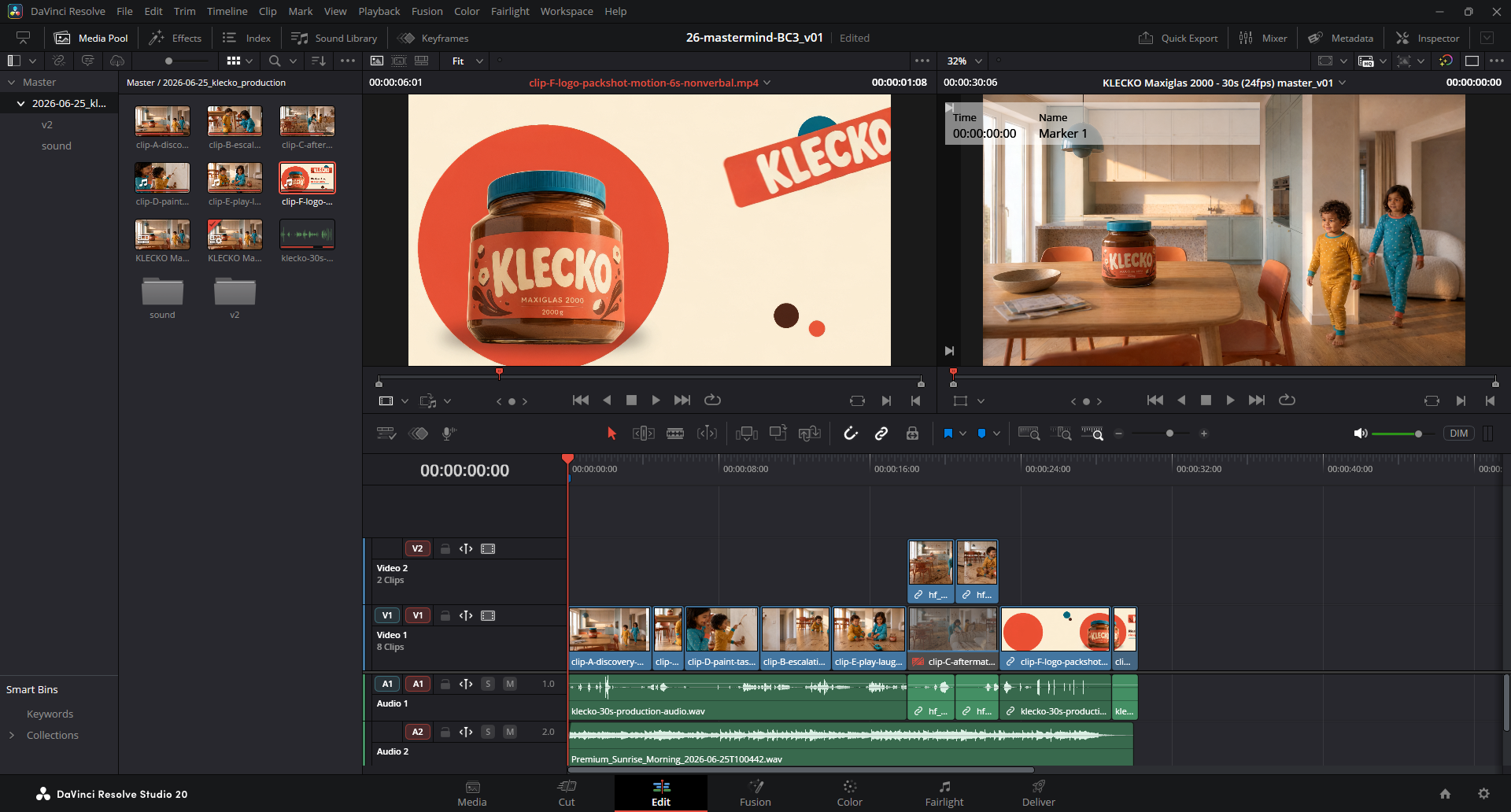
A spot like this used to be specialist work: casting, location, a child on set, camera, lighting, a shoot day, then the edit. This time it ran differently. From the first idea to the cut clip took a few hours in a single day.
Two things sit at the heart of the engine room:
higgsfield over MCP is the orchestration layer. MCP (Model Context Protocol) is the standard plug an AI agent uses to talk to external tools directly. Through the higgsfield MCP my agent doesn't talk to one model — it conducts several: an image model for the product design, one for the characters, a video model for the motion, all in one connected pipeline, with a cost check before every expensive step. Honestly, how smoothly this runs now is seriously impressive.
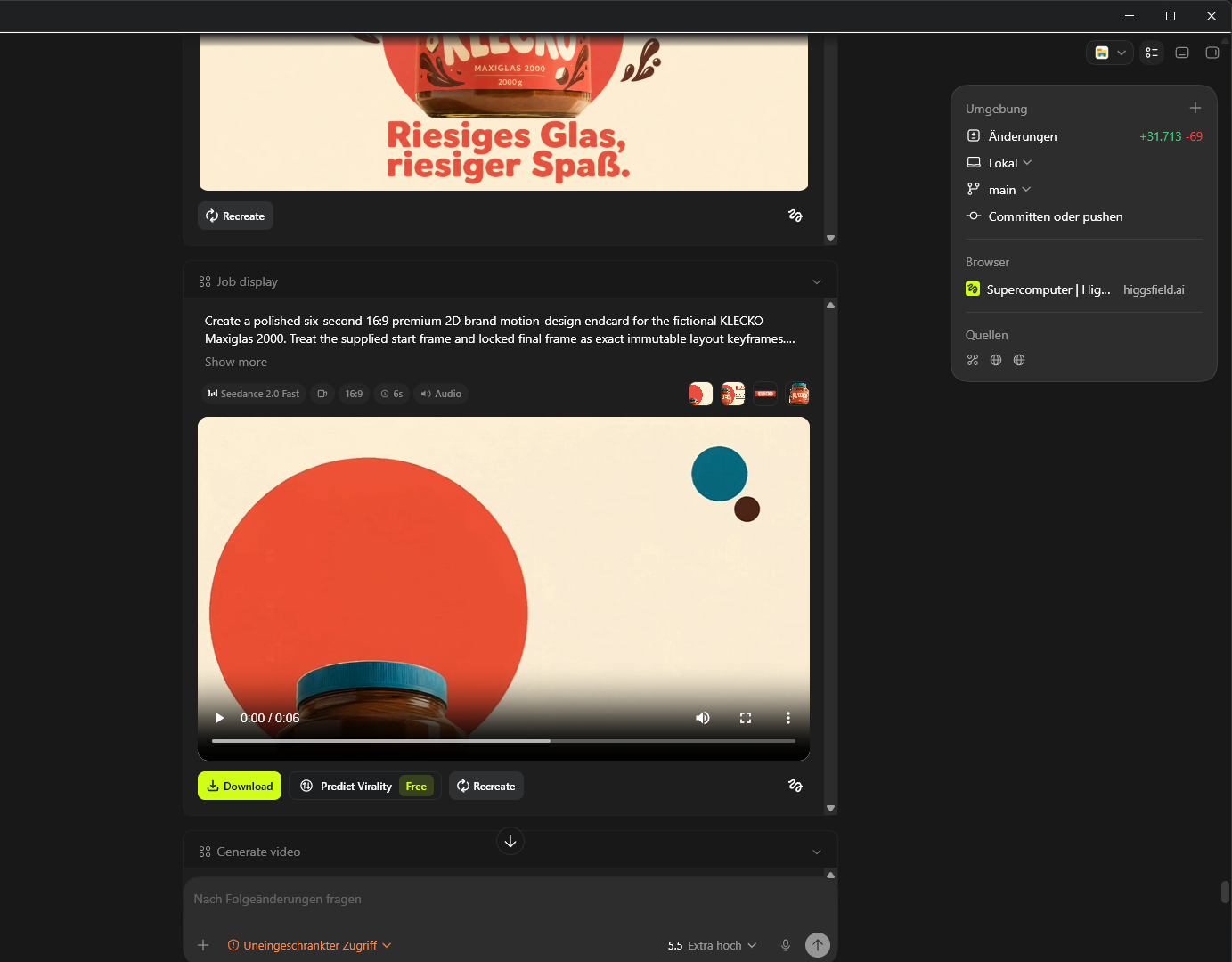
Seedance 2.0 is the video model that turns stills into fluid sequences. And it's genuinely great — good enough that a few seconds of it pass, at first glance, for real footage.
The key point: none of these tools "does everything." The magic isn't one all-powerful model — it's specialized models working together under control, through an interface an agent can drive.
Higgsfield's MCP is a skill system — almost like mine
This is where it gets genuinely interesting for me. "Higgsfield MCP" sounds like a button. When I took it apart, it was something I know very well: a skill system.
Underneath sits a very similar approach to the one I spent months building myself — small Markdown "skills," each with one clear job, a CLI as the shared tool beneath. Higgsfield goes one step further and adds a thin MCP layer for the agents on top — which I don't have (yet). But the same disciplines:
- A size limit per skill (their "300-line rule" ↔ my "as small as possible" diet)
- Offloaded references (detail moves into separate files ↔ exactly my pattern)
- Eval suites (they test skills against scenarios ↔ my gates)
- Version sync with CI, separation of decision and execution
- Guardrails ("never invent model names" ↔ my "don't guess, prove it")
- Approval gates before delivery
And what's public is just the tip: a handful of official skills sit in front of a much larger real surface — dozens of models, dozens of tools. Small door, big apparatus behind it. Sounds familiar.
So the real insight isn't "AI makes video." It's: the orchestration layer — skills that conduct models — is becoming the standard build. Two parties who never coordinated land on the same underlying pattern.
And this is exactly where a tool parts ways from a system. Higgsfield's kit — and mine — are generation layers: strong at producing one clip, one image, one sequence. But my skill system doesn't stop there. On top sits a production layer that does what generation alone can't:
- a binding world bible as the single anchor for look, tone, world, characters, locations and props — feeding every downstream prompt instead of reinventing each clip;
- a structured entity library: every character, location and prop gets an ID, fixed attributes and an approved reference — reusable across hundreds of images;
- machine-enforced continuity: a gate that checks the building blocks against each other and blocks contradictions before they propagate through the episode;
- approval gates at every stage that let nothing unverified through — plus a directing signature, defined once and carried consistently throughout.
The kit generates. The system produces — repeatably, consistently, at series scale. That's what becomes the real value once generation itself turns into a commodity. (That's Parts 2 and 3.)
"It's only the preview"
Here's the part I want to stress, because it almost always gets lost:
What you see in the clip is Seedance 2.0 at 720p, "Fast" mode — deliberately the cheapest, quickest preview tier. This is not a final, polished render. It's a test in preview quality, chosen to iterate fast and cheap.
Read that again: this isn't what the machine can do. It's what it spits out on the side, in economy mode, as a draft. If even the throwaway preview looks like this, you can imagine where the road leads. That's exactly why I show the preview and not the polished final — the message is in "the test alone already holds up."
And it gets better: I took only the first or second attempt per image and per clip — no cherry-picking from twenty runs. Some images honestly aren't optimal. Anyone who invests 5 to 20 retries per shot pulls out visibly more: errors disappear, quality climbs. So you're seeing the quick, unpolished state — and that's the point. That even the second take carries like this was simply unthinkable before Nano Banana, GPT Image 2 and Seedance 2. Compared to everything that came before, these models are extremely good, even without optimization. And the same pattern ran through every craft — the voice-over (ElevenLabs v3) and the music landed on the second take, too.
When the limit hit, another one simply took over
Then something happened that gave me more to think about than the clip itself.
Mid-production my main agent — Claude Code — hit its usage limit. Not long ago that would have meant a production stop. This time a second agent (Codex) took over the same pipeline, the same references, the same state — and carried it to the finish. No break, no rebuild.
That's the genuinely underrated headline: the agent, the model, the vendor under the hood are becoming interchangeable. Claude today, Codex tomorrow, something else the day after. What generates turns into a commodity. What counts is the system around it — the pipeline, the constants, the control. (Part 3 is exactly about that.)
The AI now reviews, too
One more thing that's new in the workflow: the agent didn't just generate — it helped select. Codex screened image and video variants, discarded weak ones and passed only the usable ones on — a review step that used to be pure manual labor. The fact that AI now sits at the table for image and video review speeds the whole thing up again.
Mind you: pre-selecting is not directing. Which shot is dramaturgically right — and which is merely technically pretty — is a different question entirely.
The uncomfortable truth
Which brings me to the sentence that, honestly, nagged at me a little while I was building this:
Basically anyone can do this now.
Two tools, one afternoon, a bit of taste — and a presentable ad falls out the back. That used to be my craft. Sixteen years of film and CGI, and the barrier to one good clip just shrank to an afternoon project. Any pro who looks at that and doesn't swallow hard hasn't really looked.
I don't find it threatening — I find it fascinating. But I also find it honest. This series won't pretend the skill stayed scarce. It didn't. A single spot is cheap today.
And that's exactly where the interesting question begins.
What's next
If two tools are enough to build one convincing spot in an afternoon — what's left for someone like me?
The honest answer starts where the magic stops: at the second clip. At episode two with the same kids, the same apartment, the same product, the same light. Part 2 next week shows where the tools hit a wall — a wall the image model invented, in the wrong spot, three times in a row in my production. It's about consistency. And consistency is the point where "fun gag" suddenly becomes "real problem."
Sources
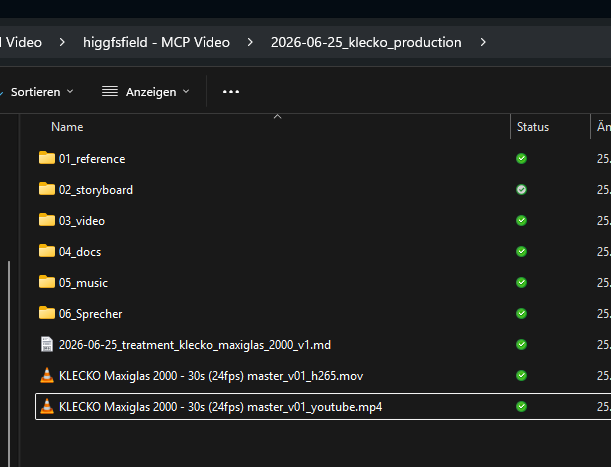
This field report rests, in substance, on my own production data — the production log, the prompts and the asset states of the KLECKO production from 25 June 2026. These internal records aren't publicly linkable; the figures cited (Seedance 2.0 at 720p "Fast," first/second attempt only, three short clips of 5–6 seconds, one production day, voice-over via ElevenLabs v3, music via ElevenLabs Music v2) come from that log.
The few external, general terms are standard definitions: MCP (Model Context Protocol) as an open standard for AI agents to call tools; higgsfield as a generative video/image platform; Seedance 2.0 as a video model. Concrete platform facts were verified before publication against the official sources (fact-check 26 June 2026: higgsfield.ai/mcp for MCP + model access, Seedance 2.0 as ByteDance SEED's video model).
AI disclosure: The video is fully AI-generated and labelled as such — an on-screen "AI-generated parody" at the start plus an end card listing the tools used (transparency in line with the EU AI Act, Art. 50). Fictional brand, no real product.
Jens Fehrmann does AI-assisted video and series production in live-action and 2D style — real productions with AI as a pipeline component, for agencies, production companies, brands and creators. New production methods in use first, delivered reliably. Backed by experience in film and CGI since 2010, from Dresden.
Keep the conversation going?
Prefer LinkedIn? Let’s connect there. Prefer one-on-one? Message me directly — you reach me, not a team.